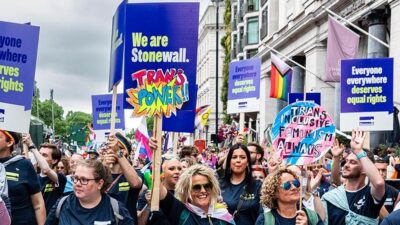
“We don’t all have to agree 100% on everything,” but together we progress: Angela Mason CBE on LGBTQ+ history and activism
Angela Mason CBE is a long time LGBTQ+ activist and one of the first directors of Stonewall, who spent decades driving change for LGBTQ+ communities. She received an OBE for her work on ‘homosexual rights’ causing a stir when the citation was read out at the Palace.
From campaigning for equal rights to shaping some of Stonewall’s earliest work, Angela has been part of many of the landmark moments that define LGBTQ+ history. In today’s climate, it can be easy to lose sight of how far we’ve come. During these turbulent and challenging times, LGBT+ History Month offers an important opportunity to honour the past while celebrating progress and innovation and, in numerous instances, persistence. Below, Angela shares her reflections.
The importance of LGBT+ History Month
For Mason, initiatives like LGBTQ+ History Month remain vital:
“It allows us to find ourselves, to respect and honour those who have gone before, to learn from our mistakes and successes so we can go forward with confidence and pride. We grow up, often, in heterosexual families, so we always need to find our own history to understand ourselves.”
Memorable moments in Stonewall’s early years
Reflecting on her time helping to establish Stonewall, Mason recalls the organisation as “a virtual Roman candle of exciting moments.” One memory stands out: organising the first LGBT mass lobby of Parliament in February 1994, ahead of the vote to equalise the age of consent.
“Knee-deep queues of supporters lined up outside Parliament, and the lobby was full of young gay men flirting behind the statues! It represented the power of the movement against Section 28 in 1988/9, which had been growing stronger and now demanded full equality,” she remembers.
Mason also recalls introducing Edwina Currie, Former Government Minister, to musician and LGBTQ+ activist Jimmy Somerville during the event, a symbolic meeting of minds. Although the vote was narrowly lost, the demonstration marked the first big public sign of a progressive alliance that would ultimately “dismantle centuries of discrimination”.
Turbulent and challenging times
Mason acknowledges that every movement faces tension because “all political movements are by their nature turbulent”. In Stonewall’s early years, there were disagreements with activist group Outrage over strategies for achieving equality.
“I think both I and Peter (Tatchell) saw them as part of creating a wider democratic movement for change. It helped that we had both been in Gay Lib [Gay Liberation Movement] together… movements of men and women working together, respecting each other, and trying to question patriarchy.”
Early allies of LGBTQ+ rights
Some figures and initiatives, Mason believes, have not always received the recognition they deserve. She highlights the important role of the Greater London Council (GLC), later the Greater London Authority (GLA), and Ken Livingstone in advancing equality in the 1980s.
She notes that he was among the first politicians in England to recognise the importance of women’s and gay liberation, racial justice, and LGBTQ+ equality, and that he established a dedicated trans committee at a time when such issues were rarely discussed in public life.
Mason also points to the GLA’s London Partnership Register, launched in September 2001, as a key precursor to civil partnerships and later legal recognition. Developed in close collaboration with Stonewall, the scheme enabled more than 1,000 couples to formally register their relationships. Stonewall went on to lead the campaign for civil partnerships, drafting the first Bill with Lord Lester which received wide support in the House of Lords.
While she strongly condemns Ken Livingstone’s later views, many of which are offensive and deeply problematic, she emphasises that his early support for LGBTQ+ rights played a significant role in shaping subsequent reforms.
Innovative approaches to activism
When asked about effective strategies for driving change, Mason highlights the evolving digital landscape:
“The dominance of the internet and social media seem to have changed the lives of everyone but especially the marginalised such as lesbians and gays and trans men and women. To defend our rights, it’s important to understand what life is now like, what the pinch points are, what the opportunities are, and how love and friendship have changed.”
She notes that targeted campaigns against homophobic bullying, and workplace discrimination remain essential, even after all these years.
Living through moments of change
When asked what she would say to people considering supporting Stonewall’s work today, Mason points to the long fight to lift the ban on LGBTQ+ people serving in the armed forces as a clear example of how sustained campaigning can lead to real change.
During her time at Stonewall, she was closely involved in lifting the military ban, which banned LGBTQ+ people from serving in the British military. The ban had a devastating impact on many people who wanted to serve their country. People were criminalised, imprisoned, dismissed, and often stripped of their medals.
“It was wonderful seeing members of the armed forces who had been thrown out and disgraced by the ‘homosexual ban’ now finally receiving compensation,” she says.
She recalls that the campaign was far from straightforward. The Labour government at the time was hesitant to act, leaving campaigners with little choice but to pursue justice through the European Court of Human Rights in Strasbourg.
“We had to rely on Strasbourg to win our case,” she explains.
The eventual lifting of the ban in 2000 marked a major victory, but for Mason, the recent compensation scheme represents a long-overdue recognition of the harm that was done.
Meeting former campaigners and service personnel at a Stonewall reunion, including Elaine Chambers and Robert Ely of Rank Outsiders, reinforced for her why this struggle had mattered so deeply.
“It was their stories that inspired this part of my work at Stonewall,” she reflects.
Mason also emphasises the crucial role played by legal teams in turning campaigning into concrete results, paying tribute to Peter Duffy, Stephen Grosz of Bindmans, and David Pannick KC.
Sustainable and long-term change is created through a mix of societal change and legislative action
Looking to the future, Mason is clear that legal reform alone will not be enough. Asked what changes are most urgent today, she points first to the political climate.
“Undoubtedly, the most urgent issue we face is the rise of the extreme right she says. “They are profoundly opposed to everything we have fought for.”
To meet this challenge, she argues for building a broad “progressive alliance” across different movements and communities.
“We don’t all have to agree 100% on everything. We must learn, through discussion, often face to face, what goals and tactics we can pursue together.”
She suggests that LGBTQ+ organisations could help initiate this process through national conversations and shared events, bringing our own LGBTQ+ communities and making links with migrant and refugee organisations, trade unions, women’s rights groups, Black and Asian communities, and climate activists.
Drawing on historical examples such as Cable Street and Rock Against Racism, Mason stresses that progress has always depended on cooperation and collective action, “it is these alliances that have halted the far right and built a new constituency for social justice.”
Angela reminds us, progress is never inevitable, we must fight for it. And hard won rights are not always secure. There is much more work to be done, hate crime against LGBTQ+ people persists, conversion practices are still legal in the UK in 2026, and many trans people are feeling worried following the Supreme Court ruling last April.
Stonewall continues to campaign for the legislative change that will shape LGBTQ+ lives. If you want to help shape the next chapter of LGBTQ+ history, consider supporting Stonewall’s campaigns.